Serological Screening
Our Serology Section
What we do
Our Serology Section is primarily responsible for the detection and identification of biological material (blood, seminal fluid, and saliva) on physical evidence in order to:
- Search items of evidence for possible biological fluids using a variety of different alternate light sources and magnifying lights.
- Document and describe items of evidence using photography, sketches, and detailed notes.
- Utilize the latest tools and techniques to locate stains or other possible areas of interest for DNA testing.
- Attempt to identify blood, seminal fluid, or saliva on items of evidence.
- Attempt to determine if biological fluid could be human.
- Look at possible hairs to determine if a root tag suitable for nuclear DNA testing is present.
- Identify areas of interest on items of evidence to swab for trace DNA.
-
How we do it
Analysts in this section follow a systematic process to analyze evidence:
- Evidence Documentation and Evaluation: Physical evidence is carefully documented and evaluated for the potential presence of biological materials. Biological stains may or may not be visible to the naked eye.
- Sample Collection and Preservation: Biological samples are collected and preserved for further analysis.
- Testing: Analysts select and perform appropriate tests to identify potential biological materials. These tests may include chemical, enzymatic, immunological, and/or microscopic techniques.
Learn more about serological screening
Click or tap on a topic below to jump to that section.
Techniques for visualizing biological stains
Biological stains can be difficult to see. The Serology Section uses the following techniques to visualize these stains:
- Visual Examination: Evidence is initially examined visually.
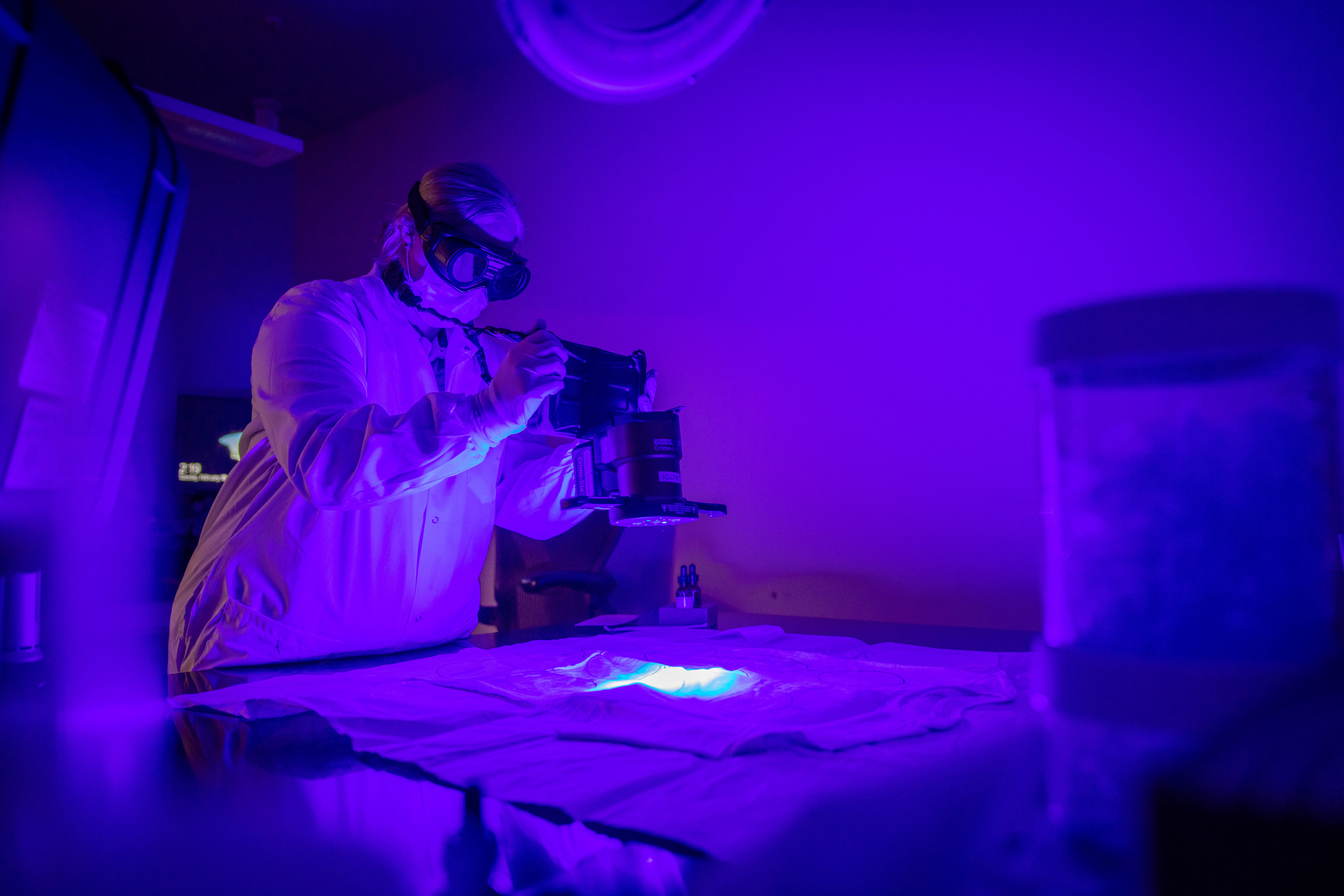
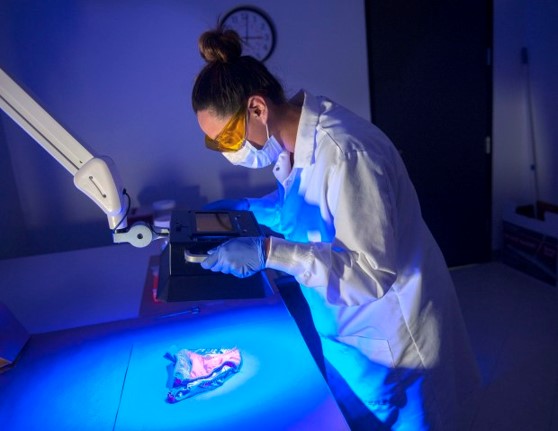
- Alternate Light Source (ALS): Specialized light sources are used in a darkened room to make some biological stains fluoresce, making them visible.
-
Analysis of specific biological materials
Blood
- Presumptive Test:
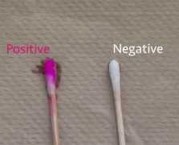
- The Kastle-Meyer (KM) Test is a presumptive test for blood, involving a color change reaction. A pink color change indicates that blood may be present.
- It's important to note that the KM test is not a conclusive test for blood, as other materials that do not contain blood may also give a positive result.
- Confirmatory Test:
- Analysts use an immunological test to detect human hemoglobin, a protein found in red blood cells, to confirm the presence of blood.
Seminal Fluid
-
Presumptive Test: Analysts use the Acid Phosphatase (AP) Test as a presumptive test for seminal fluid. This test involves a color change reaction. A purple color change indicates the possible presence of semen.
-
It's important to note that the AP test is not a conclusive test for seminal fluid, as other materials may also give a positive result.
-
Confirmatory Tests: To confirm the presence of seminal fluid, analysts use compound microscopes to search for sperm cells on slides prepared from swabs, clothing, etc.
A staining technique called the “Christmas Tree Stain” is used to prepare the slides. This technique stains the heads of sperm cells red and the tails green.
If sperm cells are not located, analysts may perform an immunological test for proteins that can be found in seminal fluid.
Trace (Touch) DNA
- Evidence found at a crime scene may be submitted for the collection of skin cells for DNA analysis.
- This evidence is swabbed and submitted for DNA analysis.

Working with other forensic disciplines
- The Serology Section's work often overlaps with other forensic disciplines.
- Biological stains are forwarded to the DNA Section for analysis.
- We also coordinate with the Latent Print, Firearms, and Fire Debris sections, and may work with Trace Evidence for fiber collection, depending on the specific needs of a case.