DNA Analysis
Our DNA Section
What we do
The DNA Laboratory at the Utah Bureau of Forensic Services (UBFS) provides critical DNA analysis services for criminal investigations throughout Utah.
Our team of forensic scientists is dedicated to:
- Analyzing biological evidence to identify the source of DNA.
- Comparing DNA profiles from evidence to known samples from individuals.
- Maintaining and utilizing Utah's DNA Database (SDIS) to support law enforcement.
-
How we do it
Our forensic scientists use advanced scientific methods to ensure accurate and reliable results:
-
Evidence Screening: Analysts screen biological evidence from various crimes to locate materials suitable for DNA analysis, such as blood, semen, saliva, and skin cells.
-
DNA Extraction: We use specialized techniques to isolate and purify DNA from the collected biological materials.
-
DNA Typing: Our lab utilizes Autosomal Short Tandem Repeats (STRs) and Y-Chromosome STRs to generate highly discriminatory DNA profiles.
-
Database Utilization: We upload eligible DNA profiles to Utah's State DNA Index System (SDIS) and the National DNA Index System (NDIS) to search for matches with profiles from convicted offenders, arrestees, and other crime scenes.
-
Expert Testimony: Our forensic scientists provide expert testimony in court to explain the results and significance of their findings.
Learn more about DNA analysis
Click or tap on a topic below to jump to that section
Introduction to DNA analysis
- The goal of DNA testing is to identify the source of biological material.
- UBFS performs nuclear DNA testing by analyzing Short Tandem Repeats (STRs) through PCR-based typing.
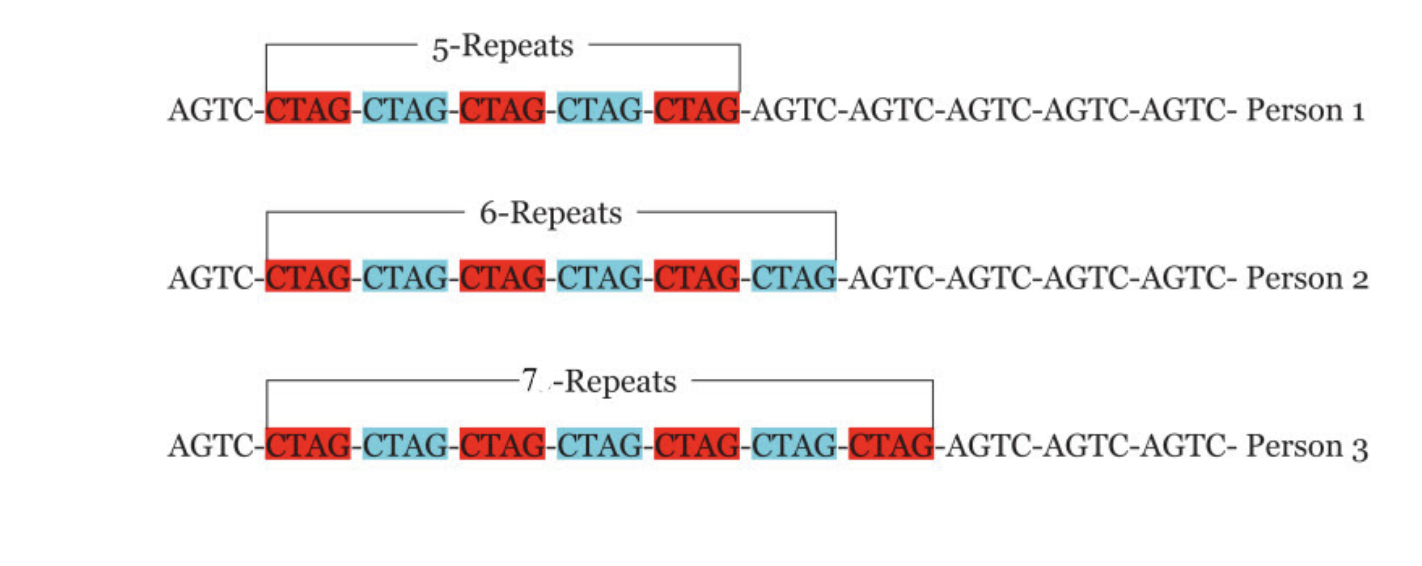
- STRs are short sequences of DNA that repeat a certain number of times. The number of times these sequences are repeated varies between individuals.
- These STRs are found at specific locations along the chromosomes. Each individual has two copies of each location (locus) examined, one inherited from each parent.
- STRs are highly discriminatory, as the combination of alleles across a large number of loci can be unique to an individual, with the exception of identical twins.
- Read more about STR analysis in this article from the National Institute of Justice.
DNA Analysis: STR Testing
Our analysts develop DNA profiles using a method called Short Tandem Repeat (STR) testing.
Science Simplified: What are STRs?
STRs (Short Tandem Repeats) are short, repeating sequences found in our DNA. While the sequences themselves are common, the number of times they repeat at specific locations varies from person to person.
By analyzing the number of repeats at multiple locations, our analysts create a unique DNA profile for an individual, much like a genetic fingerprint. (The only exception is identical twins, who share the same DNA profile).
This profile from a crime scene can then be compared to a known sample (a reference sample) from an individual.
Types of STR Testing We Perform
Autosomal STRs
This is the standard method of nuclear DNA testing used to identify the source of biological material.
-
How it works: This test examines STR markers across a person's general chromosomes (autosomes), which are inherited from both parents.
-
What it tells us: A comparison can result in a match (inclusion), an exclusion, or an inconclusive result.
-
Why it's important: By analyzing a large number of these STR locations, we can create a highly discriminatory profile that is unique to a single individual, making it a powerful tool for identification.
Y-Chromosome STRs (Y-STRs)
This is a specialized method used to evaluate the male component of a DNA mixture.
-
How it works: This test only looks at STR markers on the Y-chromosome, which is passed directly from a father to his sons. Because of this, all males in the same paternal family line (father, sons, paternal uncles, etc.) will have the same Y-STR profile.
-
What it tells us: A Y-STR profile can either exclude an individual or include him and all of his male relatives from his father's side.
-
Why it's important: This test is invaluable in sexual assault cases where a small amount of male DNA might be mixed with a large amount of female DNA. While it can't identify a single individual, it's a powerful tool for providing a crucial investigative lead when other methods fail.

DNA profile comparison
- Once a DNA profile is developed from the evidence, it can be analyzed and compared to the DNA profile developed from known samples submitted from individuals, often referred to as reference samples.
- These comparisons can result in exclusions (the DNA is not from the individual), inclusions (the DNA is from the individual), or inconclusive results (the evidence does not support either conclusion).
